Inductees
Tim Richardson
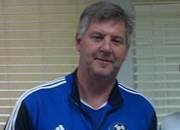
Tim Richardson looks back at the beginnings of his soccer coaching career in the 1980s and is almost in awe with how far the game, and he, has come.
With soccer gaining popularity in the Kansas City area, Richardson took over the soccer program at Lee’s Summit High School in 1985.
“Initially, we didn’t have our own practice or game field on campus,” he said. “Kids and coaches had to drive to a park or other locations that had a field. Fields were bumpy grass and dirt. Balls were a hard plastic/ vinyl.”
Eventually, he said, school districts realized that soccer was well-supported in the community and steps were taken to improve facilities and conditions for the sports.
It’s no argument that the success of Richardson’s teams had a big hand in that. For nearly 40 years, Richardson led soccer teams at Lee’s Summit and Lee’s Summit North, building successful programs for both boys and girls squads. For that career, the Missouri Sports Hall of Fame proudly inducted him into the Class of 2025.
Richardson coached soccer at Lee’s Summit from 1985 to 1994 and then moved to Lee’s Summit North from 1995 to 2014.
Between the two schools, his boys and girls teams were a combined 743-272-84. He was 452-195-66 in 29 seasons coaching the boys, and 291-77-18 in 16 on the girls side. Those marks are easily within the Top 25 of all-time wins by a Missouri high school soccer coach.
Six of his Lee’s Summit North girls teams reached the Class 4 Final Four: the 2000 team won state, while the 2002, 2009 and 2012 teams were state runners-up. The 1999 and 2007 teams were third and fourth, respectively.
Richardson’s love of the game started during his childhood in Brazil, where he also played basketball and volleyball and ran cross country at The Americana School de Belo Horizonte.
He played soccer at Kent State University, where he earned team MVP in his final three seasons and was first-team all-region as a senior.
Two years later, his coaching career began.
“I was hired in 1985 at Lee’s Summit High School to replace a retiring coach and to teach science,” he said. “The program was well-established and had good talent. It was my first coaching experience. There were several challenges due to my inexperience so it took me a few years to commit to coaching as a career.”
A trip to Portland, Ore., to attend a coaching clinic led by Graham Ramsey helped Richardson develop his coaching philosophy.
“As a kid playing street soccer in England, he got hit by a car and lost one eye. That did not deter him from becoming a pro player and then a coach,” Richardson said. “I was inspired by his knowledge, coaching ideas, respect for the game and more. For many years, I attended his clinics during the summer.”
At one point, he met Bill Arrandale in St. Louis.
“We stayed in touch, and it worked out for him to become an assistant coach in our program at North,” he said. “We coached together for many years and shared ideas and approaches along the way. I learned a lot from Bill.”
Richardson also completed coaching licenses through the US Soccer education organization.
“We promoted those ideas within the programs,” he said. “We worked hard to be better coaches and encouraged our players to have the same approach in the classroom and on the practice and playing field. We upheld our standards.”
When Richardson looks back, it’s not just the wins and accolades that makes him proud. It’s former players who became coaches.
“One in particular was Ryan Kelley,” he said. “As a player he was a hard-nosed, no nonsense, team oriented. Over the years as a coach, he displayed the same character. Incredibly loyal, great with the players, would do anything that was needed. Another player, Mike Johnson, who held the season scoring record at North for many years, became a coach in our program and did many positive things to help our younger teams.”
Richardson emphasized he knows he didn’t do it alone.
“My wife, kids and parents helped me. My wife was always supportive. I did a lot of soccer outside of the high school realm, which took up even more time and she carried the household load for many years,’ he said. “Administrators, supporting teachers, maintenance workers who helped with fields, all the coaches in the program and in other programs at the high schools. I learned a lot from them.”