Inductees
Rhesa Sumrell

Rhesa Sumrell says softball wasn’t even the sport she enjoyed most as a young person. She was a multi-sport athlete growing up
“My trajectory into the game of softball was more of a logistical business situation,” she said. “I wouldn’t say it was my favorite sport, but it became the sport that I spent most of my time coaching.”
However, she got into coaching the sport, things certainly worked out for Sumrell.
Over the course of nearly 30 years, Sumrell racked up enough wins at Missouri Western State University and then at the University of Central Missouri that she became one of the top 25 winningest coaches in NCAA Division II history.
That success and her dedication to the sport makes the Missouri Sports Hall of Fame proudly inducted Sumrell with the Class of 2025.
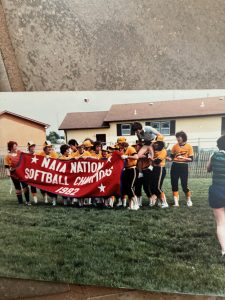
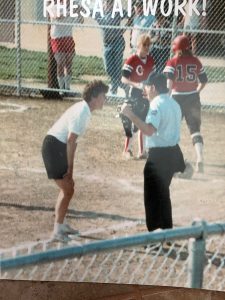
Sumrell coached softball from 1979 until 2006, first at Missouri Western and then at the University of Central Missouri. Overall, her teams were 822-527.
She served as coach at UCM from 1988 until 2006, retiring as the winningest coach in Jennies softball history with a 614-359 record in 19 seasons. Her UCM teams captured four MIAA regular-season championships and four MIAA Tournament titles, with three runner-up finishes.
The Jennies won NCAA Division II regionals in 1989 and 1994 and had a pair of regional runner-up finishes. Two UCM teams finished in the top four in the D-II Tournament.
At Missouri Western, Sumrell was 195-150 with three consecutive trips to the NAIA Tournament. She was the NAIA Coach of the Year after her 1982 team won the national title.
Sumrell not only developed an eye for talent, but also for personality and attitude.
“You know, the most obvious answer is recruiting,” she said. “And not only recruiting good athletes, but recruiting good people who would carry on the culture that you try to build over the years and pass it on from one team to the next.”
She also said she owed much of her success to fellow coaches who led women’s teams. Women’s sports have come a long way since Sumrell’s first year coaching in 1979 and today’s coaches are able to draw from resources that weren’t available back then.
“When I first started coaching in women’s athletics, there were very few of us who were dedicated solely to the women’s side,” she said. “It’s not like today when there’s so many coaches and female athletes and they all coach one sport. We all coached everything and we learned from each other. We didn’t have a lot of knowledge when we started coaching, so we had to share and we enjoyed sharing. I think I learned so much from my colleagues and hope that they learned something from me.”

Rules changed, different ways of doing things came and went, but she had the tools and support necessary to navigate them.
The challenge, she said, was keeping up with changes among athletes themselves.
“I never changed my honesty and my coaching style because it would’ve been changing my personality and I probably coached the same way at the end as I did in the beginning,” she said. “When I first started coaching, the female athlete was just thrilled to have the opportunity to compete and play the game they loved. By the end of my coaching career, they were much more entitled and probably more of an all-about-me generation and that made it really tough to coach a team sport.”
Through the years, Sumrell coached 12 players who combined to earn 18 All-American honors. She learned early that student-athletes thrive when you set the bar high. The more you expect, the more they’ll produce.
“I think the most important thing that I learned is that if you have high expectations of your student-athletes as athletes as well as people that they live up to those expectations,” she said. “I also learned that you can’t please everyone and that you, as a coach, must do what is best for the team. It’s the hardest part of coaching. It’s not always what’s best for an individual, but you have to put the team before the individual.”
As much as she enjoyed the winning, the best part was being around quality players and coaches.
“Above and beyond all that, I think it’s getting together with some of the young women that you coached and hearing their memories,” she said. “They very rarely were about winning and losing, but about the friendships that they made and the friendships that lasted a lifetime.”