Inductees
Jim Carr


Jim Carr gave a lot to athletics growing up, and it gave a lot back to him.
Growing up in Mississippi, he experienced athletic success at both the high school and collegiate levels, earning induction into the Halls of Fame at both Gulfport High School and Millsaps College.
So when he was trying to decide which career path to follow after college, he kept coming back to athletics.
“Like a lot of college juniors and seniors, I was trying figure out what to do,” he said. “My mom heard about a master’s in sports management program and that sounded really interesting. Early on in that program I knew that college athletics was my passion.”
That passion has led to a long and impactful run for Carr as President and CEO of the NAIA, or National Association of Intercollegiate Athletics. For his years of innovation and growth with the association, the Missouri Sports Hall of Fame proudly inducted him into the Class of 2025.
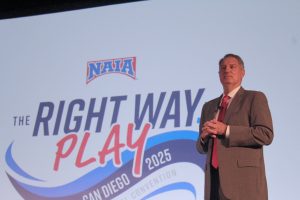
Carr graduated from Millsaps College and earned the master’s in sports management from the University of Massachusetts before earning a law degree from Duke University. He joined the NAIA in July 1998 as Managing Director and General Counsel. In September 2006, Carr became the seventh president and CEO of the NAIA.
During his tenure, Jim has led the organization through significant growth and innovation. A few notable new initiatives are Champions of Character, the NAIA Eligibility Center, National Association of Collegiate esports and Return on Athletics. Growth of the NAIA is highlighted by offering 30 championship sports to more than 87,000 student-athletes, including the men’s basketball national championship that started in Kansas City in 1937 and remains there today.
“We’ve tried to help members understand what the NAIA is and what we stand for,” he said. “Our Return on Athletics program has helped education university presidents on how athletics can have the most positive impact on their institutions and how it can drive the bottom line for the campus as a whole.”

When Carr joined the NAIA, the association’s headquarters were in Tulsa, having moved from Kansas City a few years earlier. An immediate effort began to find a new home for the NAIA.
After a national search, the NAIA returned to the Kansas City area with a new home in Olathe, Kan. Six years later, the association moved again, returning to downtown Kansas City, where it still is today. From Carr’s office, he can easily see Municipal Auditorium, home of the NAIA Men’s Basketball Tournament for more than 80 years.
“It was such a success when we moved the basketball tournament back to Municipal Auditorium in 2002, a lot of things just fell into place,” Carr said. “We came back to our roots. We have a lot of great support here. It’s meant to be in Kansas City. As long as I’m president, and I think for a long time after that, the NAIA will be in Kansas City.”
Carr led Gulfport High School basketball to a state championship before compiling a standout basketball career at Millsaps College.
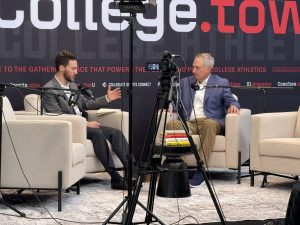
He said he still draws from lessons he learned as an athlete.
“Certainly, I draw from my legal education and my formal education,” he said. “But the things I learned in team sports still apply to all parts of my life. The simplest is the strength of being a good teammate, being a part of something bigger than yourself and relying on others.
“Going back to high school, I wasn’t necessarily the most gifted athlete, so I had to learn how to outwork people, not give up, and stay disciplined. That has served me well.”
Carr has served or currently serves on many boards, including USA Basketball, USOPC, Kansas City Life, Police Athletic League of Kansas City, Missouri Bank and Trust, NAIA Champions of Character Foundation, National Association of Collegiate Esports, and Millsaps Board of Visitors.
While new challenges will continually show themselves – including the new era of transfers and name, image likeness (NIL) deals, Carr is excited and confident about the future of the NAIA.
“There will always be things to work through, but I really think there a lot of opportunities for us,” he said. “We can’t stop students from transferring, but we can educate them on how, statistically, transferring can be challenging to them getting their degree. We can help them make the best decisions.
“There will always be lot of chances to run college athletics like they were intended.”