Inductees
Edwin Evers


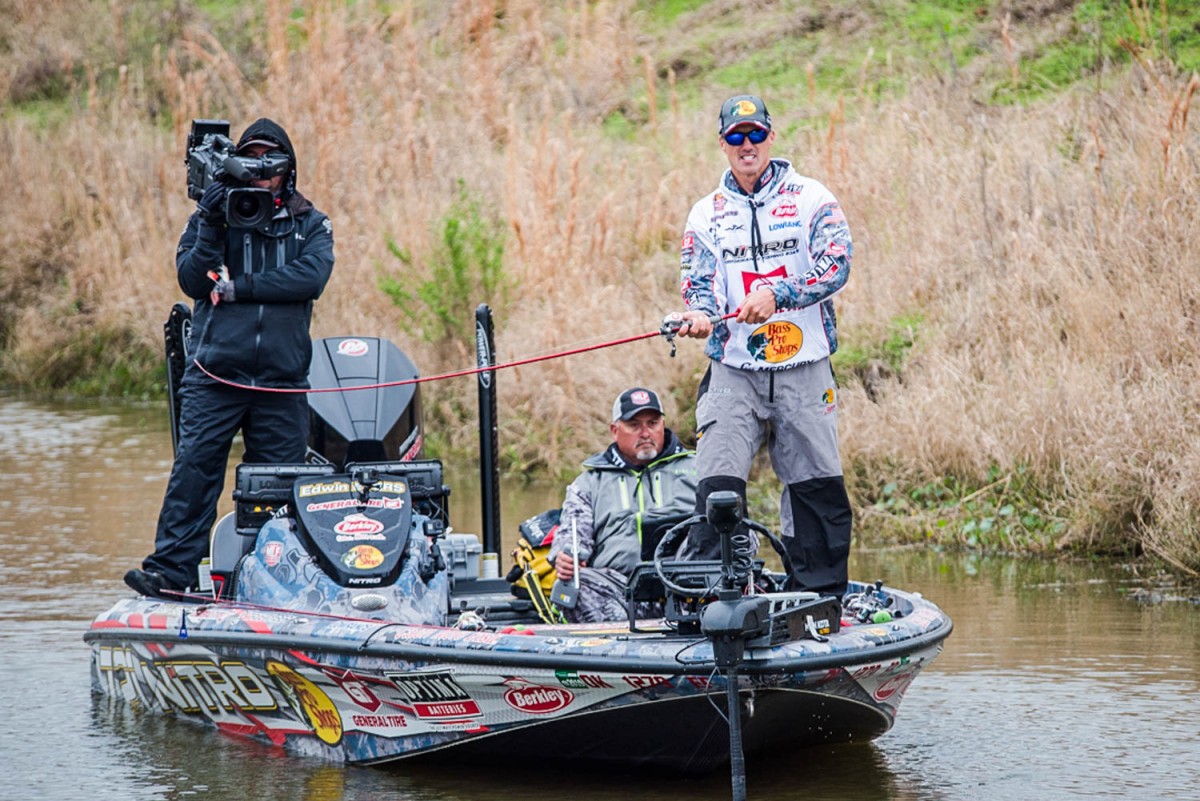

He wasn’t about to pack it in, go home and call it a career even though many would have understood. He had come too far for that.
This was in 2002, when Missouri native and professional angler Edwin Evers, with his wallet thin, felt the real world tugging on his line far more than the fish.
“I had used all the money I had, so I didn’t have any money to get home,” Evers recalled of an event in Georgia at age 28. “I prayed that night. I needed to make a living fishing or go back home and get a job.”
Evers (pronounced E-vers) rallied the next day and used the momentum toward becoming a Bassmaster regular – and eventually a star on the Major League Fishing circuit. It’s an incredible story, with success worthy of Evers’ induction into the Missouri Sports Hall of Fame, with the Class of 2021.
Born in Louisiana, Missouri and having spent part of his childhood around El Dorado Springs, Evers is one of only five competitors in history to pass $3 million in career winnings, with the official count at $3,688,943 million.
His resume features 16 major wins and 119 Top 20s in a 22-year career. That includes 11 victories in the Bassmaster series – including in 2016 when he won the Super Bowl of the sport, the Bassmaster Classic – and five victories in Major League Fishing.
Additionally, Evers is the winner of the 2019 REDCREST, MLF Bass Pro Tour Stage Two in Conroe, Texas, and Bass Pro Tour Angler of the Year.
With the success has come sponsors. Lots of them, actually. They are Bass Pro Shops, Nitro Boats, General Tire, Optima Batteries, Mercury Marine, Berkley, Lowrance, TrueTimber, Wiley X, Luna Sea Cush-It and Navionics.
And to think that, not long ago, it almost never happened.
The turnaround in 2002 was on Lake Seminole in southwestern Georgia. He was starting at 96th on the leaderboard and staring up at the ceiling that night. The next day, he found a flat and hauled in 22 pounds, vaulting to 16th place.
Later that season, Evers made the Bassmaster Classic. It was the first time he had qualified in two years.
“It was 100 percent God’s doing,” Evers said of the 2002 Lake Seminole finish. “I had been trying do it all by myself. I tried to be bullheaded. But then I decided to leave it in His hands.”
Evers certainly has come a long way as a self-taught angler. As a kid, he fished from the banks of the Mississippi River north of St. Louis – he caught his first mudcat on a Snoopy pole – and later tested Lake Stockton by El Dorado Springs.
Eventually, he attended high school in Seneca, Illinois before playing football for Southeastern Oklahoma State University in Durant, in the southeast part of that state.
Sitting 12 miles to the west and south of campus was Lake Texoma. Naturally, it was a magnet for Evers and cemented his decision to become a professional angler. That probably was no surprise, considering Evers, in his youth, asked for guide trips as birthday and Christmas presents.
Competing in tournaments was not new. He had been entering them since the seventh grade, when he won his first – along with $500 – by catching five bass, which combined to weigh 10 pounds.
In 1996, he was on Bass Pro’s state team. A couple of years later, he went from renting a house to buying a $7,500 trailer home. He then won his first boat in a U.S. Anglers Choice tournament and, while that may not seem like much, it would be for any young pro.
That tournament’s top two finishers won bass boats worth roughly $20,000 each. Evers sold his and used the money toward entry fees to continue competing. In 2000, he qualified for the Bassmaster Top 150, finishing 120th. And then came the turnaround at Lake Seminole the next season.
This for an angler who loves East Texas waters (Sam Rayburn and Toledo Bend) as well as Lake of the Ozarks, Grand Lake in Oklahoma and the Great Lakes.
Through his career, he admired other pros such as Stacey King (MSHOF 2020), Rick Clunn (MSHOF 2017) and Mark Davis. But because of the nature of pro fishing, he didn’t have a true mentor.
Instead, he came to learn numerous ways to find success, by relying on electronics, renting airplanes to scout lakes ahead of tournaments and reading up on lakes’ histories.
Said Evers, “It’s just out-working your competition.”